Let’s connect
Designed by Yours Truly


NVIDIA Earnings Analyzer
[AI-Powered Financial Sentiment Analysis Tool]
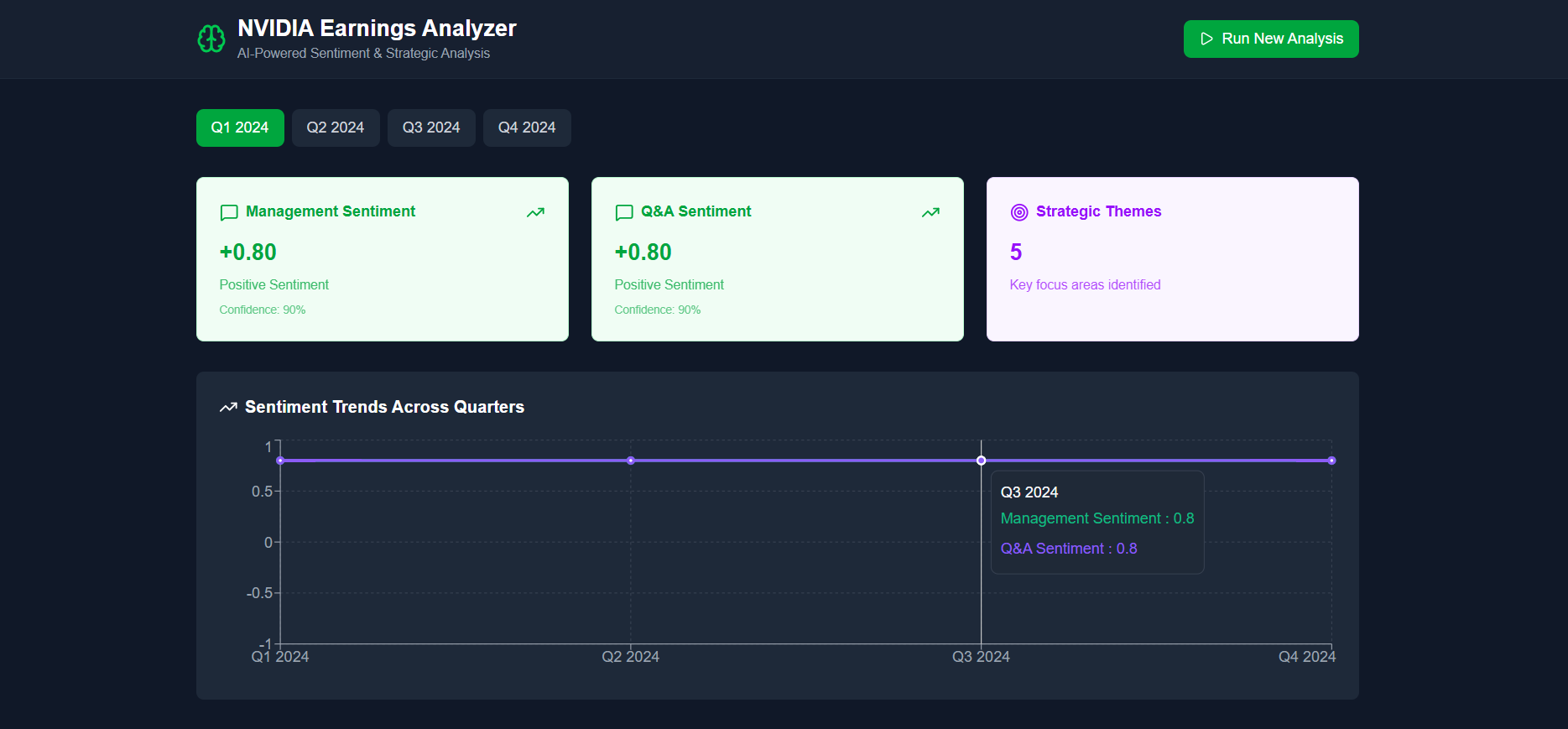
An intelligent web application that automatically analyzes NVIDIA's quarterly earnings call transcripts to extract sentiment trends and strategic insights. Built with Next.js and TypeScript, the tool leverages OpenAI's GPT-3.5 Turbo API to process four quarters of data simultaneously, identifying management sentiment, Q&A tone shifts, quarter-over-quarter changes, and key strategic focuses. The React-based interface uses Recharts for interactive data visualization, while Axios and Cheerio handle transcript collection, reducing hours of manual analysis to under 90 seconds.
[The Problem]
Financial analysts and investors need to quickly understand sentiment shifts and strategic direction from quarterly earnings calls, but manually reading through lengthy transcripts is time-consuming. NVIDIA's earnings calls contain critical insights about AI market trends, but extracting actionable intelligence requires hours of analysis.
[My approach]
I built an AI-powered application that automatically processes four quarters of NVIDIA earnings transcripts to extract sentiment trends and strategic themes, reducing analysis time from hours to minutes.
Key Features:
- Dual sentiment analysis - Separate scoring for management remarks vs. Q&A sessions to capture different tones
- Trend tracking - Quarter-over-quarter sentiment comparison with significance indicators
- Strategic theme extraction - AI identifies 3-5 key business focuses per quarter with confidence scoring
- Interactive visualization - Charts and theme cards make complex data immediately understandable
[Technical Implementation]
AI Pipeline Design: I structured the OpenAI GPT-3.5 integration with carefully crafted prompts to extract four distinct signal types from unstructured text. The system processes transcripts through multiple analysis stages, each with confidence scoring to ensure reliability.
Data Collection Challenge: Real-time web scraping faced anti-bot measures from financial websites. I implemented a fallback system that attempts collection from multiple sources (Seeking Alpha, Yahoo Finance, Motley Fool) before gracefully degrading to structured sample data, maintaining the full analysis pipeline regardless.
Rate Limiting & Performance: Built in 1-2 second delays between API calls to respect OpenAI rate limits while keeping total analysis time under 90 seconds for all four quarters. Used Next.js API routes to handle backend processing and prevent client-side API key exposure.
User Experience: Created an intuitive interface with quarter selector tabs, interactive Recharts visualizations, and a searchable transcript viewer. Used TypeScript throughout for type safety and better developer experience.
[outcomes & reflections]
The final application delivers a complete sentiment analysis dashboard with four-quarter trend comparisons, strategic theme extraction, and searchable transcripts, reducing analysis time from hours to under 90 seconds. This project taught me a lot about working with AI APIs in practice. Designing effective prompts for structured outputs was trickier than expected, and the web scraping challenges forced me to build resilient systems with graceful degradation. I gained real experience with rate limiting, API optimization, and balancing performance with service constraints. If I built this again, I'd skip web scraping entirely and use a financial data API, add database persistence for analysis history, and expand beyond single-company analysis to enable comparative insights across multiple tech companies.
Github
Live Demo